Search engine optimization (SEO) isn’t something that happens overnight. If you do your research, put in the effort, and take the necessary steps, it can still take 6 months to a year before you start seeing meaningful results. Sometimes longer.
Even then, there are no guarantees.
You may do everything right, only to find yourself struggling to rank high for a seemingly easy keyword. You may also see great results in the beginning, only to get stuck for the following months.
Does that mean you stop your SEO efforts? No. Doing so can result in rankings dropping off by 30% or more.
So you keep going, trying to at least keep things as they are.
But a little over a year ago, while we were finishing up some work for one of our clients, we proposed a question to him…
What if We Could Do More Than Maintain Rankings?
The Richards Firm has been doing SEO for about 6 years. They saw some great initial results, and they’ve generally maintained those results. Most of their targeted keywords were in the top 10 spots, while a few always seemed to lag behind. Organic traffic stayed pretty much the same every year, as did contact form submissions.
Everything was fine, but looking at similar businesses in his region, I couldn’t help but shake the feeling that we could do better.
What if we not only increased current rankings, but we found new opportunities for rankings, further optimized the site, and ultimately grew organic traffic by a significant amount for the first time in years.
Of course, that wouldn’t mean much if we didn’t improve conversion rates. So, we went to work.
The Results
There’s a lot to consider when measuring the success of a website, some of which is difficult to explain here. Also, we don’t want to give away all of our secrets. But it’s safe to say we’re seeing some great results a year or so later.
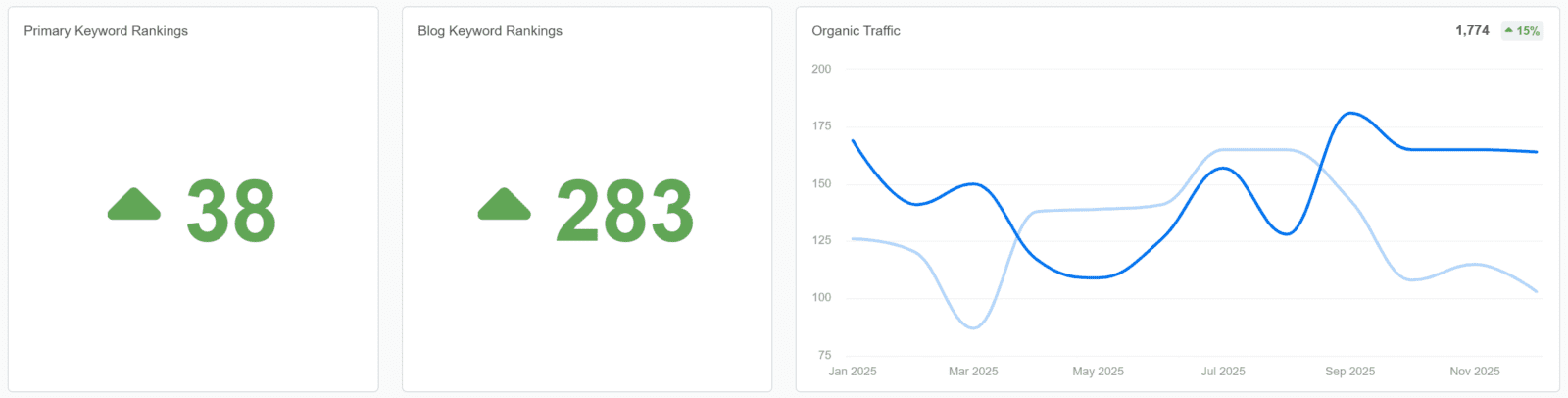
In 2025, we saw organic traffic (that’s search engine traffic) increase by 15%. This is in a year where overall organic traffic across the entire internet actually decreased by 2.5%, and it happened on a site where traffic had largely plateaued.
The last three months of 2025 alone brought in 150 more organic visitors than 2024, which is an increase of 52%.
Meanwhile, contact form submissions are up 43% for the first two months of this year compared to last year.
Additionally, we’ve seen the primary keywords that had previously plateaued increase by 38 places across Google.
And finally, we saw a new batch of keyword-focused blog posts jump up 283 ranking spots in Google search results. This has been critical to driving new traffic, while also establishing The Richards Firm as an authority in their field (something that’s increasingly critical for search engine results).
How did we manage to do all of this? Let’s take a look.
What We Did
We talked previously of the brand voice updates we made to The Richards Firm website. This gave us the foundation we needed to build on. We also worked to establish their fairly standard blog as a more robust content and resource library.
It starts with making sure all of the basics are covered. While much of this was done when the site was originally created, things can begin to slip over time. Pages are added and edited by different people. URLs change, resulting in broken links. The site becomes bloated and unoptimized. Meanwhile, rules and best practices across the industry are constantly changing.
We ran an in-depth SEO audit. This helped identify issues like:
- duplicate meta descriptions
- overly long titles
- content shortages on pages
- redirect/broken link errors
- and more
This provided us with a simple punch list to work through, marking off each issue as it was updated. With all of these issues addressed, it was time to roll up our sleeves and let the real work begin.
Deeper, Longer Content
The Richards Firm had quite of a bit of content from the previous years. This is what had helped it achieve the rankings it had. However, the requirements for SEO content had changed since that work began. This resulted in many of the past posts being overlooked by Google.
In order words, they wouldn’t show in search results, they wouldn’t reach people in need of their information, and they wouldn’t boost SEO performance.
So, using Google’s Search Console, we started tracking down posts that were failing to be indexed, and we began reoptimizing them.
How to Optimize Content for Google
Google never tells you exactly what to do to rank high in their search results. If they did, people would exploit every basic rule and likely break the system. Instead, they provide general guidelines and best practices in hopes that people will work to create better content designed for real people.
This has become especially critical in a world of AI slop.
The general guidelines for modern content are:
- Focus on people, not search engines
- Demonstrated experience and expertise
- Topical authority across interconnected pages
- Helpful content that answers follow up questions
- Clear user pathways and engagement signals
On top of that, posts are expected to be longer than they once were. Ten years ago, a 400-500 word blog post was just fine. Today, the average length of top Google results is 1400 words.
Working off these general guidelines, we systematically started expanded and updating old posts. As for new posts, we took things a little further. Each post would be based around a specific keyword or phrase. Using modern SEO tools, we would find high traffic questions and phrases that were being overlooked by competitors.
This would allow us to greatly expand the reach of the site and the opportunities for rankings. A year later, we have numerous posts showing on the first page for their targeted keyword.
Stronger Interlinking and Intentional Indexing
Interlinking is a critical piece of an SEO strategy. It’s what allows Google to truly see what keywords you’re targeting, so it can pass value accordingly. It also simply provides more opportunities for Google to see your content and insure it gets indexed accordingly. As we mentioned earlier, a number of posts weren’t being indexed properly. Often, this was because they weren’t fully optimized to modern standards.
But other times, Google was simply missing or ignoring them.
An increased focus on interlinking within individual posts, as well as across various pages helped to alleviate this issue. Additionally, we made sure to manually index any new or updated content.
This is something we’ve talked about previously in regard to how to get your content on Google. While some say that manual indexing is unnecessary and excessive, we’ve found the opposite to be true in recent years. Taking this approach has resulted in a massive improvement in relevant content appearing on Google.
Adding a Pop-Up
Pop-ups can be the worst. We know. But they can also be very effective, especially when used correctly, and especially on mobile. Simply having an exit pop-up can save more than 10% of abandoning visitors. And so, we added a simple, minimally invasive pop-up that appears for new visitors.
And guess what? People are actually clicking on it and making form submissions through it.
This is something we’ll be experimenting with more this year, but even the most basic version has brought positive results.
Better Tracking
All of this work sounds nice, but it doesn’t mean much if we’re not keeping track of it all. Of course, general keyword and Analytics tracking has been done since the start of The Richards Firm website. This year, however, we took things further, ensuring there was proper data tracking for all contact form submissions, phone calls, resource downloads, and pop-up interactions.
Seeing ranking and traffic numbers go up is great, but these new metrics allow us to truly see if the site is doing a better job of driving business and helping people.
And as we’ve previously said, the answer to that is yes.
SEO Still Matters in a World of AI
The rapid rise of AI has understandably had people questioning a lot of things. One of those questions is does SEO even matter in an AI-driven society? While people are certainly using ChatGPT for complex questions (and questionable advice), Google still remains the most visited website in the world.
 And though AI has grown immensely over the last few years, it still only accounts for 1% of referral traffic according to recent studies. Meanwhile, organic traffic remains the healthiest and most interactive form of website traffic.
In our own work for The Richards Firm, organic traffic had less than half the bounce rate of direct traffic. Organic visitors also stayed on the website 3x longer than direct, referral, or paid traffic.
Knowing this, it comes as no surprise that SEO traffic is often 2-3x more likely to convert than other sources.
We’re excited to see how much further we can go with The Richards Firm in 2026, and so are they:
“We cannot thank Timothy and This Blank Page enough for everything that makes our website among the best in our field. We would put our SEO game up against any of our competitors. In our space, too many firms spend hundreds of thousands on advertising a year. We feel that legal advertising can be beneath the profession and choose not to participate in those traditional advertising forms. To that end, we would not be where we are without our strong, vibrant, attractive website. Thanks, This Blank Page. Cheers to more collaborative work ahead.”
Rhys Richards | The Richards Firm
If you’d like to see what we can do for your business, we’d love to connect. You can view our unlimited content strategy plans here.
Don’t have a website or a brand voice strategy in place? We can help with that too.